Lineage of the Knight Bachelor of Yugoslavia

Lineage of the Knight Bachelor of Yugoslavia in
the Pontifical Imperial State and United Roman-Ruthenian Church

Peter II, King of Yugoslavia
Sir Alan Weaver-Hazelton and Sir Robert Elwood Gamble
Prince Robert de St. Germain-Iler
Baron Johnson*
RadislavI, Bishop of Rome-Ruthenia

*Additionally attested by brevet from Peter II

Brevet of the Knight Bachelor of Yugoslavia
held in the Stephenian Archives


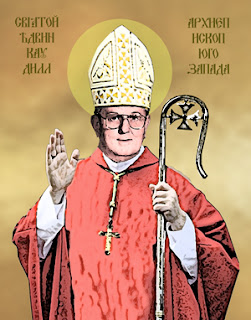
Art Commissioned for the 30th Anniversary of the Consecration of Saint Edwin Caudill, Bishop of the Southwest


 Art commissioned by the Apostolic See in the 30th anniversary year of the consecration of Saint Edwin Caudill in orthodox and catholic Apostolic Succession. It depicts the consecration of Saint Edwin (Bishop Howard Edwin Caudill, Bishop of the Southwest) by Macario V. Ga, Supreme Pontiff of the Philippine Independent Church, and Bishops Frank Benning and John Hamers. 21 October 1993, Holy Cross Polish National Catholic Church, Brooklyn, New York. Bishop Caudill was Bishop of the Southwest. Some years after his repose, the remnants of his See went into the Apostolic Communion of Anglican Churches in 2008 and ceased to be part of the "Continuing Anglican" movement. Later it was renamed the See of St. Stephen and became the Coadjutorship of Rome. Joined with the Anglo-Roman Metropolitan Archdiocese of Aquileia, it became the Apostolic See of Saints Stephen and Mark, the principal See of the United Roman -Ruthenian Church

(The historical archives of the Archdiocese of the Southwest as housed in the Stephenian Archives contain a photograph of the actual consecration.)


Saint Edwin Caudill, Bishop of the Southwest


Original icon of Saint Edwin Caudill
by the Apostolic See of Sts. Stephen and Mark

Saint Edwin Caudill is considered and venerated under the title of "Apostolic Founder and Confessor" of the Apostolic See of Saints Stephen and Mark. His Grace the Right Reverend Howard Edwin Caudill, Bishop of the Southwest was canonized in 2023 by H.H. Radislav I, Bishop of Rome-Ruthenia, the direct successor to Bishop Caudill and the Diocese Southwest. That diocese was later renamed the See of St. Stephen, and after a merger became the Apostolic See of Sts. Stephen and Mark. 

Sometime after the death of Saint Edwin, his diocese (the Anglican Diocese of the Southwest) suffered a schism. The remnants in time went into the Apostolic Communion of Anglican Churches, with H.H. Radislav I (then-Bishop Johnson) later becoming its Bishop Ordinary as the eventual successor to Bishop Caudill. It subsequently was created a Metropolitan See and later was renamed the See of Saint Stephen in recognition of its evolution as an Orthodox Old Catholic diocese, it became the Diocese of Rome-Ruthenia and the principal See of the United Roman-Ruthenian Church. Because Saint Edwin's original diocese evolved, over a decade after his death, into the principle diocese of the United Roman-Ruthenian Church, he is considered the Apostolic Founder of the United Roman-Ruthenian Church. 

The first liturgy in which the name of Saint Edwin was invoked was celebrated on 30 April 2023 by the Bishop of Rome-Ruthenia according to the Gallo-Russo-Byzantine Rite. The cause for canonization was opened in 2008, the 10th anniversary of Bishop Caudill's death. 
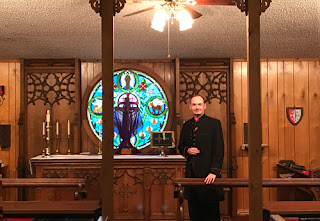
H.H. Radislav I visits the former Cathedral of St. Chad,
First Chair of the United Roman-Ruthenian Church, as the cathedral
of Saint Edwin Caudill as Bishop of the Southwest

Taken from Il Nunzio Romano: 

Although Saint Edwin Caudill was not the first Bishop of the Southwest (in fact he was the second), he was consecrated not only in succession from the Episcopal Church of the USA, but also in diverse Orthodox and Roman Catholic Apostolic succession through the Philippine Independent Catholic Church. He was consecrated in succession from the two Holy Fathers of the Apostolic See, Pope Saint Leo X and Saint Aftimios Ofiesh. Through him, the diocese also branches in Apostolic succession from the Greek Orthodox Patriarchate of Jerusalem (through Patriarch Damian I) and the Coptic Patriarchate of Alexandria (through Pope Cyril VI of Alexandria). This is the legacy of unified Christianity that the modern Apostolic See perpetuates, and it began with Saint Edwin as Bishop of the Southwest. 

For more information about Saint Edwin Caudill, please visit this link. Additional information is also available on this page. For more about the United Roman-Ruthenian Church, please visit this page.
Saint Archbishop Aftimios Ofiesh


Saint Aftimios Abdullah Ofiesh was born in Lebanon and was originally a cleric in the Eastern Orthodox Church of Antioch. He came to the United States in 1905 and eventually served as Bishop of Brooklyn, New York, in the Russian Orthodox Church from 1917 to 1933, immediately succeeding Saint Rafael of Brooklyn. In the midst of the canonical disputes following the Bolshevik Revolution in Russia, he was commissioned to establish the American Orthodox Catholic Church under the auspices of Eastern Orthodoxy. He serves as the head of that church until his death in 1966.

In 1933, Saint Aftimios married Mariam, a parishioner of St. Mary's Syrian Orthodox Church in Wilkes-Barre, Pennsylvania. He was buried in Wilkes-Barre, and his widow wrote a biography of his life and career in 1999. Saint Aftimios became the Apostolic progenitor of several Orthodox and Old Catholic jurisdictions, including the United Roman-Ruthenian Church, around the world.

Saint Leo X


Pope Leo X, Lord of Florence, reigned as Bishop of Rome and Sovereign of the Pontifical States from 1513 to 1521. Born Giovanni de'Medici, was a member of the Medici family that ruled Florence and Etruria. Cardinal de' Medici was elected to the papacy following Pope Saint Julius II. He oversaw the closing sessions of the Fifth Council of the Lateran and led a war that successfully secure his nephew's rule as Duke of Urbino. He was also a great patron of the arts, following the tradition of his family. Perhaps most famously, he issued the Bull Exsurge Domine that excommunicated Martin Luther, effectively launching the Counter-Reformation. As such, he is the first Baroque Roman Pope.

Holy Fathers of the Apostolic See of Sts. Stephen and Mark


The Holy Fathers of the Apostolic See are Pope Saint Leo X (Roman Catholic) and Saint Archbishop Aftimios Ofiesh (Russian Orthodox). The Holy Fathers are the two principle representatives of the historic Apostolic, spiritual, infrastructural, ethnic, and cultural legacy that the Apostolic See of Rome-Ruthenia (United Roman-Ruthenian Church) inherited and perpetuates. Both are key figures in the Apostolic Succession of the modern United Roman-Ruthenian Church. They are not the founders of the Church, for the Church was founded in 33 AD by Christ. The modern beginning of the United Roman-Ruthenian Church was in 2008.

Saint Leo X, Bishop of Rome, was the first Florentine Archfather, by which the Bishop and Papa-Catholicos of Rome-Ruthenia is temporal successor to St. Peter the Apostle. The Catholicate of Rome-Ruthenia is a descendant and successor of the patriarchate founded by Saint Aftimios Ofiesh. Together they also represent the Roman-Russian ecclesiastical, ethnic, and cultural nature of the Apostolic See and the Pontifical Imperial State of Rome-Ruthenia.

The Apostolic See of Saints Mark and Stephen

Saint Alexander Nevsky, Grand Prince of Kiev, Prince of Novgorod, rejecting subservience to the Roman diocese. Although the Imperial Roman Church is Apostolic heir to the temporal patrimony of St. Peter, the Apostolic See of Saints Mark and Stephen continues that legacy of autocephalous autonomy, which has been confirmed numerous times over the last millenium, most recently in 2013, and thus is not subservient to the Bishop of Rome. Although we embrace the churches of the various patriarchs around the world as Christian brethren, this Apostolic See is not subject to any other jurisdiction.