Holy Apostolic SeeUnited Roman-Ruthenian Church
The Catholicate of Rome-Ruthenia

United Roman-Ruthenian Church


THE DIOCESE OF THE SOUTHWEST 1978 - 2009.
THE ANGLO-CATHOLIC ARCHDIOCESE OF THE SOUTHWEST FROM 2009-2011.
SEE OF ST. STEPHEN, COADJUTORSHIP OF ROME (FOUNDED FIRST CENTURY BY ST. PETER),
AND SEE OF AQUILEIA (FOUNDED FIRST CENTURY BY ST. MARK) FROM 2011.
THE APOSTOLIC SEE OF STS. STEPHEN AND MARK FROM 2023.

In Hereditary Descent from Rome and Russia and Apostolic Succession
from Saints Peter, Andrew, Thomas, Thaddeus, and Bartholomew,
AN ETHNO-RELIGIOUS NATION WITHOUT POLITICAL TERRITORY AND A STATE UNTO ITSELF
representing people across multiple modern political countries.

PRINCIPAL LITURGICAL RITES:
GALLO-RUSSO-BYZANTINE
ANGLICAN-BYZANTINE
ANGLO-ROMAN
GALLICAN

Organisation in Special Consultative Status with the
United Nations Economic and Social Council since 2019.

H.M. King Peter II of Yugoslavia


King Peter II of Yugoslavia
(art commissioned by the Pontifical Order of Knights Bachelor of Yugoslavia)

The last King to reign in the Kingdom of Yugoslavia (albeit briefly) was King Peter II of Yugoslavia. The King, a second-great-grandson of Queen Victoria and also of Tsar Alexander II of Russia, came to the throne at the age of 11 upon his father's assassination in 1934. He was forced into exile by the Nazis shortly after coming of age. Peter II's godfather was George VI of England. The legacy of Yugoslavia, held principally through the singular honour of Knight Bachelor of Yugoslavia, is among the most treasured aspects of the Slavic heritage of the United Roman-Ruthenian Church and the Pontifical Imperial State of Rome-Ruthenia.

Insignia of an Honourary Bailiff Grand Cross of the 
Yugoslavian Order of St. John (founded under the
royal protection of Peter II) with the top portion of
the insignia indicating a Knight Bachelor of Yugoslavia.
The top portion in silver bears the Serbian eagle with the
Cyrillic cypher of Peter II. The insignia was presented
in the early 2000s to H.H. the Bishop of Rome-Ruthenia
and remains one of his most valued possessions. 

After some time in England, Peter II came to the United States in 1948 and settled in Chicago, where he lived more or less for the rest of his life. The king died on 3 November 1970 in Colorado after battling a long illness. He was buried at St. Sava Serbian Orthodox Monastery in Libertyville, Illinois, an area known for its Serbian ex-patriate community. In 2013, however, it was arranged for his body to be reinterred in Serbia at the Royal Mausoleum of Oplenac.

H.M. King Peter II of Yugoslavia (right)
and H.M. King George VI of Great Britain (left)

While in the United States, Peter II, exercising his sovereign rights, established the honour of Knight Bachelor of Yugoslavia. This was organised into a society known as the Royal Association of Knights Bachelor, with the King as its Royal Protector. Today the Apostolic See of Saints Stephen and Mark is among those entitled to grant the title of Knight Bachelor of Yugoslavia - an honour rarely conferred. Various documents pertaining to the honour are also held in the Stephenian Archives. The honour is conferred through the Pontifical Order of Knights Bachelor of Yugoslavia, a successor to the Royal Association of Knights Bachelor of Yugoslavia that had been founded by Peter II. The Pontifical Order counts among its foundational legacy a nobleman who is a Knight Bachelor of Yugoslavia and knew King Peter II.

See more on this page. 

Excerpt of a brevet of Peter II conferring the honour of
Knight Bachelor of Yugoslavia held in the Stephenian Archives
of the United Roman-Ruthenian Church.

Myth vs. Fact: Successors to St. Peter the Apostle


Myth: There is only one successor to St. Peter the Apostle, and it is the Pope of Rome.

Fact: The Pope of Rome is *one* successor, but *not* the only one. As historical sources easily show, there are several successors. First, St. Peter founded the See of Antioch *before* he founded the See of Rome. So, the Orthodox Patriarch of Antioch is also a successor to St. Peter. So is the Syrian Patriarch of Antioch. Then there are eastern rite Catholic Patriarchs of the same lineage who are likewise successors to St. Peter's See. In Rome, the Bishop of Rome-Ruthenia is a *temporal* successor to St. Peter, as well as a successor to St. Mark in Aquileia. But, then the Roman Catholic Patriarch of Venice is also a successor to St. Mark, as is the Coptic Orthodox Pope of Alexandria. As another example, there are multiple successors to the See of St. Thomas the Apostle. There are plenty of other examples. The simple fact is that there are *multiple* direct successors to the Apostolic Sees. Fighting over who is the "one and only" is arrogant, denies simple historical fact, offends the rights of others, and destroys Christian unity.


Knight Bachelor of Yugoslavia


The Pontifical Order of Knights Bachelor of Yugoslavia is a religious association serving as a successor to the Royal Association of Knights Bachelor of Yugoslavia founded by H.M. Peter II, the last reigning King of Yugoslavia. The order was founded under the protection and authority of the Pontifical Imperial State of Rome-Ruthenia, United Roman-Ruthenian Church. It counts among its foundational legacy a nobleman who is a Knight Bachelor of Yugoslavia and knew King Peter II. Coupled with the Stephenian Archives, it maintains rare records of Peter II and the honour of Yugoslavian Knight Bachelor. For more, please see the page of the Pontifical Order of Knights Bachelor of Yugoslavia.

See also the other Dynastic Orders of the Pontifical Imperial State.

Lineage of the Knight Bachelor of Yugoslavia

Lineage of the Knight Bachelor of Yugoslavia in
the Pontifical Imperial State and United Roman-Ruthenian Church

Peter II, King of Yugoslavia
Sir Alan Weaver-Hazelton and Sir Robert Elwood Gamble
Prince Robert de St. Germain-Iler
Baron Johnson*
RadislavI, Bishop of Rome-Ruthenia

*Additionally attested by brevet from Peter II

Brevet of the Knight Bachelor of Yugoslavia
held in the Stephenian Archives


Art Commissioned for the 30th Anniversary of the Consecration of Saint Edwin Caudill, Bishop of the Southwest


 Art commissioned by the Apostolic See in the 30th anniversary year of the consecration of Saint Edwin Caudill in orthodox and catholic Apostolic Succession. It depicts the consecration of Saint Edwin (Bishop Howard Edwin Caudill, Bishop of the Southwest) by Macario V. Ga, Supreme Pontiff of the Philippine Independent Church, and Bishops Frank Benning and John Hamers. 21 October 1993, Holy Cross Polish National Catholic Church, Brooklyn, New York. Bishop Caudill was Bishop of the Southwest. Some years after his repose, the remnants of his See went into the Apostolic Communion of Anglican Churches in 2008 and ceased to be part of the "Continuing Anglican" movement. Later it was renamed the See of St. Stephen and became the Coadjutorship of Rome. Joined with the Anglo-Roman Metropolitan Archdiocese of Aquileia, it became the Apostolic See of Saints Stephen and Mark, the principal See of the United Roman -Ruthenian Church. 

(The historical archives of the Archdiocese of the Southwest as housed in the Stephenian Archives contain a photograph of the actual consecration.)


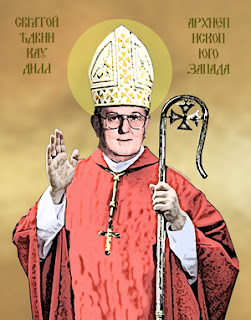
Saint Edwin Caudill, Bishop of the Southwest


Original icon of Saint Edwin Caudill
by the Apostolic See of Sts. Stephen and Mark

Saint Edwin Caudill is considered and venerated under the title of "Apostolic Founder and Confessor" of the Apostolic See of Saints Stephen and Mark. His Grace the Right Reverend Howard Edwin Caudill, Bishop of the Southwest was canonized in 2023 by H.H. Radislav I, Bishop of Rome-Ruthenia, the direct successor to Bishop Caudill and the Diocese Southwest. That diocese was later renamed the See of St. Stephen, and after a merger became the Apostolic See of Sts. Stephen and Mark. 

Sometime after the death of Saint Edwin, his diocese (the Anglican Diocese of the Southwest) suffered a schism. The remnants in time went into the Apostolic Communion of Anglican Churches, with H.H. Radislav I (then-Bishop Johnson) later becoming its Bishop Ordinary as the eventual successor to Bishop Caudill. It subsequently was created a Metropolitan See and later was renamed the See of Saint Stephen in recognition of its evolution as an Orthodox Old Catholic diocese, it became the Diocese of Rome-Ruthenia and the principal See of the United Roman-Ruthenian Church. Because Saint Edwin's original diocese evolved, over a decade after his death, into the principle diocese of the United Roman-Ruthenian Church, he is considered the Apostolic Founder of the United Roman-Ruthenian Church. 

The first liturgy in which the name of Saint Edwin was invoked was celebrated on 30 April 2023 by the Bishop of Rome-Ruthenia according to the Gallo-Russo-Byzantine Rite. The cause for canonization was opened in 2008, the 10th anniversary of Bishop Caudill's death. 
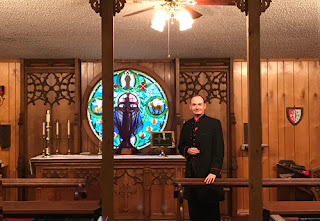
H.H. Radislav I visits the former Cathedral of St. Chad,
First Chair of the United Roman-Ruthenian Church, as the cathedral
of Saint Edwin Caudill as Bishop of the Southwest

Taken from Il Nunzio Romano: 

Although Saint Edwin Caudill was not the first Bishop of the Southwest (in fact he was the second), he was consecrated not only in succession from the Episcopal Church of the USA, but also in diverse Orthodox and Roman Catholic Apostolic succession through the Philippine Independent Catholic Church. He was consecrated in succession from the two Holy Fathers of the Apostolic See, Pope Saint Leo X and Saint Aftimios Ofiesh. Through him, the diocese also branches in Apostolic succession from the Greek Orthodox Patriarchate of Jerusalem (through Patriarch Damian I) and the Coptic Patriarchate of Alexandria (through Pope Cyril VI of Alexandria). This is the legacy of unified Christianity that the modern Apostolic See perpetuates, and it began with Saint Edwin as Bishop of the Southwest. 

For more information about Saint Edwin Caudill, please visit this link. Additional information is also available on this page. For more about the United Roman-Ruthenian Church, please visit this page.